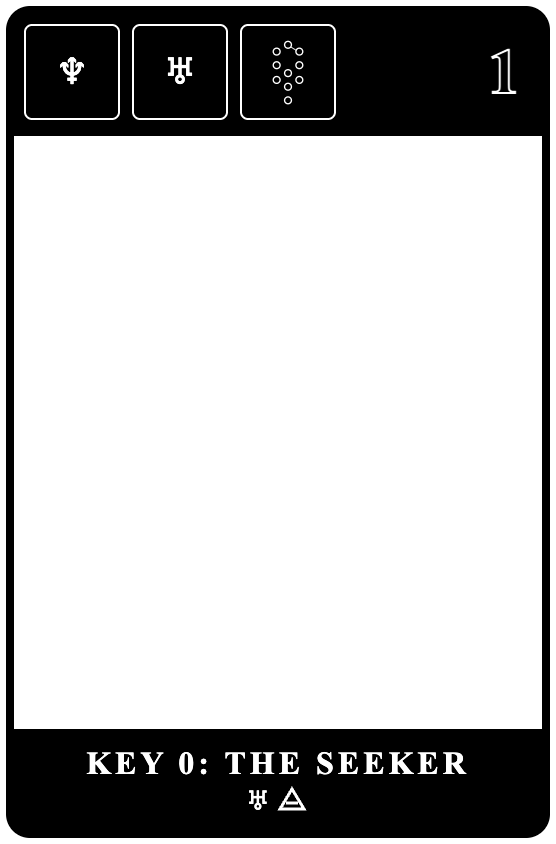
Key 0 - The Seeker
Traditional Title: The Fool
Uranus/Air
The Seeker archetype catalyzes the exploration of all potential.
Affirmation: I welcome the unknown as the beginning of infinite possibilities.
UPRIGHT: Freedom, Unconventionality, Spontaneity, Exploration, Limitlessness
REVERSE: Recklessness, Carelessness, Impulsiveness, Aimlessness, Overexertion
RIDER-WAITE-SMITH DESCRIPTION
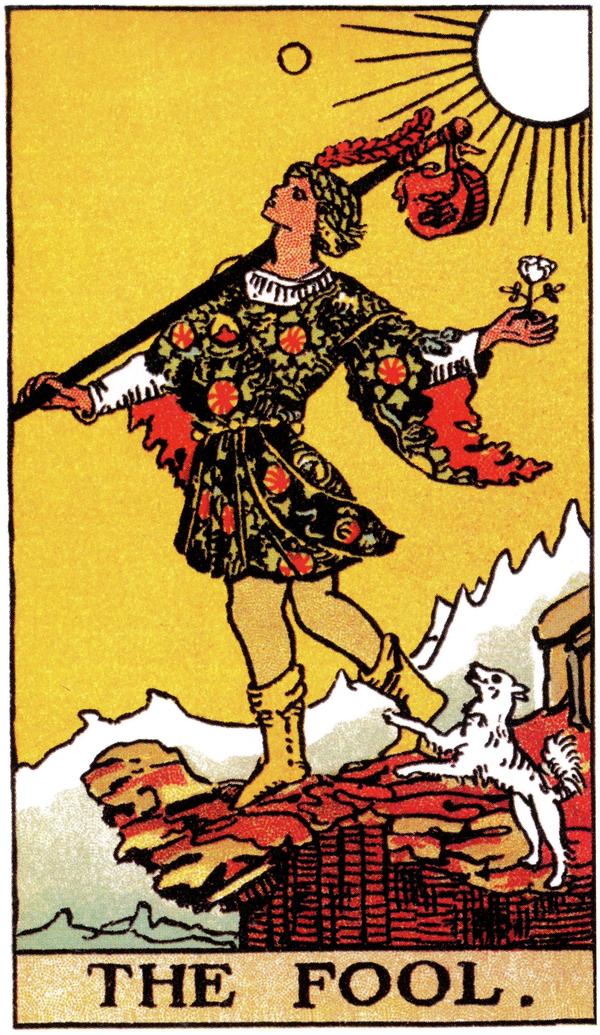
A youthful and androgynous individual is joyfully exploring their surroundings, inhaling the fresh air, and admiring the expansive land and sky from the edge of a cliff. The Fool’s gaze extends beyond their present position, fixated on distant heights. Accompanying The Fool are various significant objects, including a feathered hat, a white rose, a staff, and a satchel. A loyal and playful white puppy imitates the Fool’s gestures. This card represents the four kingdoms: the mineral kingdom symbolized by the ground, the vegetable kingdom depicted through the flower and wreath, the animal kingdom represented by the dog and feather, and the human kingdom embodied by The Fool. The Fool’s elevated position on the cliff, the yellow backdrop, his carefree demeanor, and the red feather in his cap all point to the element of air, with the feather symbolizing the Egyptian goddess Ma’at, representing truth and purity. The dominant color of the card is a vibrant pale yellow, reminiscent of morning sunshine. A white sun shines above, illuminating the snow-capped mountain peaks in the background. The white sun emanates pure light and the energy of the source, representing Kether, the first sephira. The satchel at the staff’s end symbolizes the stored memories of The Fool’s soul and their previous experiences before embarking on this new adventure. The white hue of the rose, his shirt, and his dog signify purity of purpose.
In this sense, we all begin life embodying The Fool archetype. During our childhood, we all possess a sense of wonder, innocence, and a lack of awareness about the complexities of the world, making us open and eager to learn. Everything appears as a thrilling adventure to a child, unrestricted by imagination. When the Fool archetype is embodied, there is a natural inclination to laugh, play, and embrace joy. To maintain an open stance towards the limitless possibilities available to us in any given moment, we must learn to trust the universe.
SYMBOLS
Figure: The Fool embodies a relentless seeker in pursuit of diverse experiences, relying on intuition and instinct rather than reason. This character is the protagonist found in all stories and myths, embodying the hero of a thousand faces in the archetypal journey.
Red Feather: The Red Feather, which symbolizes air, is also depicted in The Sun card on the head of the child. It represents the life force. The Red Feather also signifies truth and purity in its association with the feather of the Egyptian goddess Ma’at.
Sun: As a representation of the white light of Kether (the first sephira), the Sun radiates pure luminosity—the energy of the ultimate source. The Sun signifies source, unity, pure divinity, potentiality, and the absence of creation.
Rose: The white rose is a symbol of silence, embodying purity and innocence.
Satchel: The satchel carries the accumulated experiences of the seeker’s soul. The eagle depicted on the satchel symbolizes air.
Staff: The staff represents a fulfilled life lived in authenticity and in alignment with one’s true purpose. It serves as a guiding tool throughout the seeker’s journey.
Snow-capped mountains: The mountains of initiation symbolize the challenges and trials encountered along the seeker’s journey.
Wreath: The wreath, which serves as a symbol of transcendence, represents the triumph of pure spirit over the adversities of the world. It signifies inner strength and the capacity to overcome negative influences. In Greek mythology, wreaths signify the Sun god Apollo and represent victory.
Tunic: The white undergarment represents the light of wisdom. The black outer coat represents the realm of the unknown, while the red inner lining signifies passion and fire. The circles divided into eight sections symbolize the rising sun, representing spiritual enlightenment.
Dog: The dog, which symbolizes faith, represents the trust that empowers the seeker to venture into the unknown.
Card Details
Key 0: The Tree of Life, which serves as a profound symbol of the entirety of creation, emanates from three “veils of nothingness.” These veils that underlie the manifest universe are known as ain (nothing), ain soph (nothing without limit), and ain soph aur (limitless light). It is from these veils of nothingness that Kether, the first sephira on the Tree of Life, emerges as a point of light without dimension. Zero is the absence of quantity, quality, and mass, and its boundless nature represents unlimited potential. Zero signifies the entrance of undifferentiated Spirit into matter. This archetype signifies the negative existence from which everything emanates.
Tree of Life (Kether to Chokmah): The eleventh path on the Tree of Life commences at Kether (Crown) on the Middle Pillar, which is associated with Neptune. The path leads to Chokmah (Wisdom) on the Pillar of Force, which is associated with Uranus.
Sephira 1 (Kether): Kether corresponds to Neptune, which represents the divine source, or the Ultimate Reality principle.
Sephira 2 (Chokmah): Chokmah corresponds to Uranus, which represents the divine as an endlessly renewing force.
Value: The Fool is traditionally associated with the Hebrew letter aleph, which has a numerical value of 1. Aleph can be interpreted as the possibility of manifestation through Life Breath, or the element of air. Since the Seeker corresponds to aleph, this archetype represents the primordial breath of Life that propels all existence through the potency of Spirit. The Seeker, who is characterized by inexperience, represents superconsciousness—the cosmic Life-Breath on the verge of descending into manifestation, transcending thought, emotion, and reason.
Uranus/Air: Uranus is associated with the principles of change, reform and revolution. The beginner’s mind embodies a state of emptiness and, as the potentiality of thought (air), is free from limitations.
Platonic level (Metaphysical Principles):
The discovery of Uranus in 1781 disrupted the long-held perception of a cosmos enclosed by Saturn’s orbit. Uranus, which represents the unexpected breakup of structures, is associated with the principles of change, reform and revolution.
- Breakthrough, sudden transformation, and enlightenment.
- New beginnings.
- Revelations and awakenings.
- The acceleration of events.
- Experimentation and originality.
- Cultural ingenuity and technological innovation.
- Rebellion and liberation.
Jungian level (Psychological Principles):
Positives
- Lightning-like flashes of insight.
- The impulse for individuality and the quest for profound transformation.
- The need for independence and psychospiritual development.
- The urge to break free from old patterns, fear-based pragmatism, and outdated conventions.
Negatives
The negative expression of this archetype is characterized by erratic restlessness, resistance to structure or commitment, and a refusal to cooperate or compromise, often veering into extremes or fanaticism.
Uranus in an Astrological Chart
When any planet is in major aspect to Uranus, the second planetary archetype, which is invigorated by creativity, excitement, and innovation, is liberated into expression in sudden, unusual, or unexpected ways.
Mythic level (Mythic Deities and Figures):
Greek God: Dionysus
Dionysus, the god of wine, ecstasy, and revelry, governs the realms of unbridled joy and spontaneous celebration. He is characterized by his carefree nature, embracing the present moment and embodying the spirit of uninhibited freedom. These attributes directly correspond to the archetype of The Seeker, who similarly embodies spontaneity and the joyful exploration of life’s immediate pleasures.
Note: The qualities attributed to the planet Uranus by astrologers, such as freedom, unpredictability, originality, and individualism, do not correspond to the characteristics of the Greek mythological figure Ouranos. Nevertheless, Uranus’ association with cosmic and celestial themes, such as space, space travel, astronomy, and astrology, reflects Ouranos’ nature as the god of the “starry sky.”