DESCRIPTION
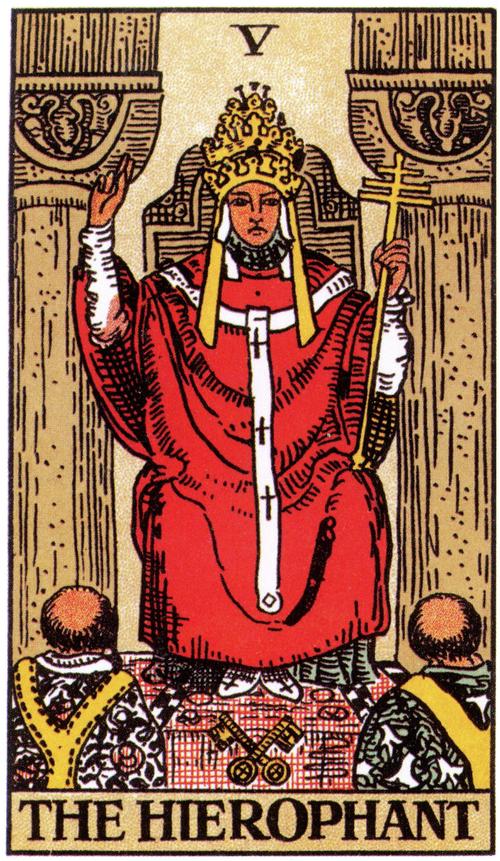
A Hierophant sits upon a throne made of stone, placed between two gray pillars in a temple. This gray color, which is the perfect blend of the opposites, is the color of wisdom. The Hierophant sits between these pillars in a very well-balanced position, aligning with the middle pillar of the Tree of Life. The Hierophant represents mediated grace and accessible faith. The Hierophant’s wears a white alb covered by a red chasuble. The red represents the active masculine principle, while the blue in the inner robe links him to the subconscious mind. His sleeves and the accents are white, symbolizing enlightenment. The Hierophant wears a triple-tiered crown, and at the crown’s peak, there is an ambiguous glyph, possibly representing three nails (the letter vav, means nail). The Hierophant holds a scepter with 3 cross bars at the top, resembling the same shape as the crown. These represent having dominion over the physical, astral, and mental planes of creation.
The Hierophant has two monks or priests kneeling before him attentively listening to his teachings. They symbolize the devotion of initiates of the mysteries. Their garments are decorated with the same flowers as we find in the Magician’s garden. His acolytes wear contrasting robes, with roses on the left and lilies on the right. While roses and red represent life force, passion, and desire, lilies and white symbolize Spirit, purity of intention, and knowledge. Desire and a thirst for knowledge are the two things that motivate the initiate on the path of the mysteries. There is a yellow shaped Y on their garments, and this is the symbol for the yoke of union. These initiates are seeking to unite their personal consciousness with the universal consciousness, and to achieve union with the one true Self. The trinity is prominently featured throughout the imagery. It is seen in the triple papal cross, the three-tiered papal tiara (worn by popes until the mid-twentieth century), three crosses on his robe, and three human figures. The trinity symbolizes the Father, Son, and Holy Spirit.
The Hierophant is depicted with the “keys of heaven” beneath his feet. The crossed keys emphasize his role as a gatekeeper. These keys represent the unlocking of the mysteries, which rest in the powers of the superconscious modes of awareness. There are four circled x’s underneath the Hierophant’s feet, which symbolize Malkuth, the physical kingdom of the four elements that is at the bottom of the Tree of Life. The Hierophant, who bridges Heaven and Earth, has his feet grounded in the world of practicality, while his head is crowned in the realm of divinity. Two of the Hierophant’s right fingers point upwards while two point downward in a gesture of papal benediction. This gesture means to be still and listen. Hearing is a key function of this archetype. This applies to listening to teachings from a mentor, as well as listening to our own inner voice. The big questions of life such as who am I, what’s my purpose, and what’s the meaning of life? represent the Hierophant archetype. The Hierophant archetype is active when we explore our inner world and devote time for our spiritual development and training. Examples of a Hierophant archetype include a Priest or Headmaster in a spiritual tradition, like a Rabbi or a guru, a Bishop, or even the Pope or Dalai Lama. The Hierophant archetype can also show up as a spiritual teacher in an institutional position or a guide who teaches and initiates others into the mystery school tradition.
SYMBOLS
Papal Crown: Traditionally the crown was placed on the pontiff’s head during a papal coronation.
Three-tiered Papal Cross: This represents the office of the Pope in ecclesiastical heraldry. The basic symbolism of a cross affirms the primary relationship between the two worlds of the celestial and the earthly; however, the three cross bar design can represent having dominion over the physical, astral, and mental planes of creation.
Two Crossed Keys of St. Peter (Keys of Heaven): These were the keys Jesus the Christ gave to Peter so that he would have power on earth and in heaven. They represent having mastery on all levels of a situation and having the authority to make binding decisions.
Gestatorial Chair: The ceremonial throne that is used to carry popes to their papal ceremonies.
Two Pillars: The gray stone pillars and throne symbolize the stable and grounded nature of Taurus, which is a fixed-earth sign. St. Peter, whose name means rock, was the original hierophant.
Two Papal Chamberlains: The priestly ministers, who are beneath the Pope in hierarchy, are tasked with the role of administration and service to those in authority.
Benediction Gesture: The Hierophant’s gesture is called the gesture of esoterism, and it means to be still and listen. Two fingers up and two down may signify the concepts of “secret” versus “revealed,” reflecting the principle of as above, so below.