DESCRIPTION
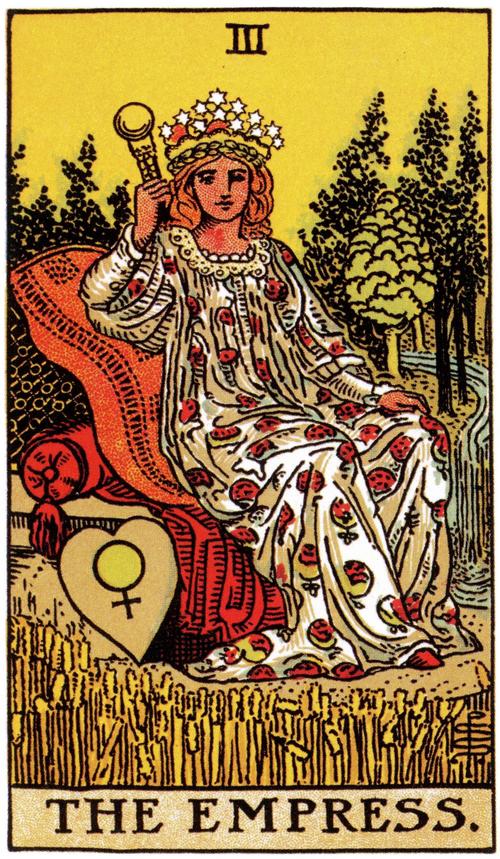
As we look at the imagery and symbolism of the Empress, we see a regal woman sitting on a luxurious cushion out in nature. The Empress is an embodiment of the goddess Venus, the goddess of love, beauty, art, sensuality, and childbirth. The symbol of Venus is depicted on a heart-shaped stone next to her throne. Although the stone itself recalls older tarot imagery, where the Emperor and Empress were depicted as worldly rulers with heraldic shields, in this deck, the Empress embodies the role of a maternal queen of love and life. The Empress represents the creative force. She wears a maternity dress decorated with Venus-shaped pomegranates. The Empress is shown enthroned and possibly pregnant, surrounded by a lush environment. The globe on her scepter symbolizes her dominion over her abode within nature.
The primary color for Venus is green, which is seen in the trees, the wreath around her head, and on the shield with a Venus symbol. The presence of evergreen trees near a waterfall could represent arborvitae or cypresses, recalling Aphrodite’s isle of Cyprus and emphasizing the goddess’s eternal and cyclical nature. This image depicts warmth, growth, fertility, and sensuality. The stream that flows in the background of the Empress, which then runs down a waterfall into a pool, originates from the flowing robe of the High Priestess. The stream of water makes the surroundings beautiful and fertile. The hair color of the Empress is blonde, which represents radiant energy. The Empress has a crown, or diadem, and on her crown are 12 stars, which symbolize the zodiac and the cycle of the year. The overall artwork seamlessly blends hewn stone, textiles, and natural elements, underscoring the idea that humanity’s creative arts are also born from the essence of the Empress.
The Empress embodies the powers of reproduction, regeneration, and renewal. As Mother Nature, she not only represents the feminine aspect, but the whole of creation, everything that manifests in time and space. The Empress represents the functions of our subconscious mind that govern creative imagination. The subconscious receives the impulses, the images, and the words of power from the conscious mind, which is a Magician. Through our consciousness of will and concentration, we implant these seeds or these ideas into the fertile ground of the subconscious. As the ideas take root, they then go into a cycle of growth beneath the surface of our awareness. At some point the ideas will sprout and bring forth new life—an epiphany, a plan, or inspiration.
In times past, the Empress would have been the Queen or the Lady of the House. Her main roles were associated with warm hospitality, sociability, beautification, and running a household. In contemporary examples, an Empress is a mother, whether she’s a mother of her own children or a mother-figure for a community. Possible careers might include nurturing professions like being a nurse, a doctor, or a healer. Her connection to nature might also drive her towards farming, landscaping, gardening, or veterinary work. Her sense of beauty and creativity might get channeled into being an interior designer, fashion designer, artist, or high-end chef.
SYMBOLS
Scepter: This scepter is surmounted by the globe and symbolic of her rulership of nature and the everyday world.
Twelve-Stared Diadem: The diadem, the metal crown with twelve stars, signifies the zodiac (heavens).
Long Gown with Pomegranates: The Empress is dressed in a garment representing her earthly royal status. Her gown is decorated with pomegranates that symbolize her fertility. She is a figure with rich vestments, which allude to her role as a daughter of heaven and earth.
Pearl Necklace: The pearls represent the birth of Venus from sea foam off the shore of Paphos in Cyprus.
Trees: The trees are rooted in the earth, but their branches point to the heavens. The trees symbolize sustainability. They withstand the onslaught of time and the elements, changing to reflect the seasons.
Stream of Water: Water gives life and purifies. It demonstrates how nature flows from one state to another.
Heart-shaped Shield with Venus symbol: In the Golden Dawn, the symbol of Venus was taught as representing unity, as it is the only planetary symbol when drawn that touches the whole of the Tree of Life. The glyph itself represents the spirit and the material.
Ears of Wheat: The ears of wheat, which symbolize germination and fertility, are in reference to the goddess Demeter who represents cultivated soil. She is known as the Goddess of the fruits (riches of the field) or the Corn Goddess.