DESCRIPTION
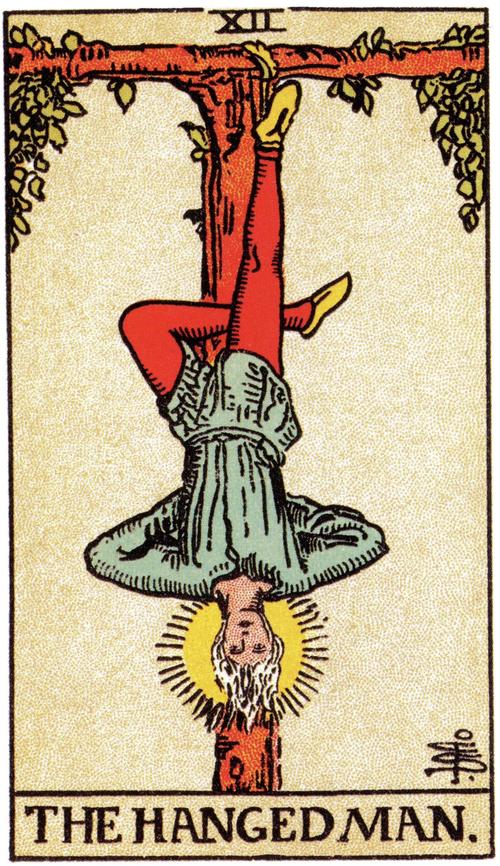
A young man hangs suspended from his right foot that’s tied to a tree shaped like a capital T. The Hanged Man’s gibbet, which takes the form of a T-shaped tau cross, resembles the shape of the Holy Cross. His other foot crosses behind it forming a cross with his legs. His arms are clasped behind his back, and he hangs with his head illuminated by a halo of yellow light. The expression on his face is very peaceful. His eyes are opened. This is clearly not an image of execution or even persecution. Although the Hanged Man had been equated with traitors and their punishment for centuries, Pamela Colman Smith’s artistic interpretation suggests the figure is a sacred outcast, perhaps even a saint. The presence of living ivy, a plant associated with immortality, adorns the cross and further emphasizes that the Hanged Man’s tree is living. His sacrifice serves eternal life, for it is through meditation that the Hanged Man knows that after death there is resurrection. According to Waite, some believe that the Hanged Man represents the cardinal virtue prudence. A more appropriate title for this card might be the Hanging Man, the one suspended between Heaven and Earth. This card represents a vantage point which brings a radical new perspective or a reversal of our thoughts and concepts. The Seeker has reached a point in his journey where he must sacrifice control of his conscious ego and surrender to his inner world. This card represents the total reversal of all knowledge that was previously gained, but so that we may more fully understand and gain an even greater perspective.
He represents the balance between human and spiritual needs, and even his clothing shows this balance. He has red leggings, which represents fire and action, but he also has a blue tunic which represents water and receptivity. The Hanged Man archetype is about reframing, which is the ability to set aside our personal viewpoint and perceive a situation in another way. It also deals with timing, waiting for that right moment to receive knowledge or initiate action. The Hanged Man archetype takes us into a trance-like state, a state of meditation or a period of suspended animation where we intensely self-examine. Upon this path, our personal consciousness can give way to universal consciousness, when we come to that point of surrender. One other important reminder that the Hanged Man gives us is that we can’t always control what happens in life, but we can control how we respond to those circumstances.
Children often look at situations from many different perspectives. They see the world through fresh eyes and with creative imagination. It’s difficult to limit or restrict a child in any way. These are all Hanged Man qualities. The Hanged Man archetype is embodied by those who forsake the luxuries of money and worldly possessions in order to dedicate their life to a sacred path. Another way this archetype might manifest is through someone who’s a death psychologist or someone who helps people dive into their subconscious and learn its inner workings.
SYMBOLS
12: This number is the reversal of 21. The World (Major Arcana 21) is turned upside-down. The World is the manifest universe hiding the divine. This card represents the divine manifesting in the universe.
T-shaped Wooden Structure: The Hanged Man’s gibbet is associated with the letter tav, a cross-shaped hieroglyph that is associated with the World card.
Figure Hanging Upside-Down: By being in a state of suspension, the figure is able to engage in deep introspection, sacrificing control of his conscious ego and surrendering to his inner world.
Halo: The halo is the most evident symbol that the figure’s sacrifice does not lead to suffering, the spirit shines through and the face expresses deep entrancement.