DESCRIPTION
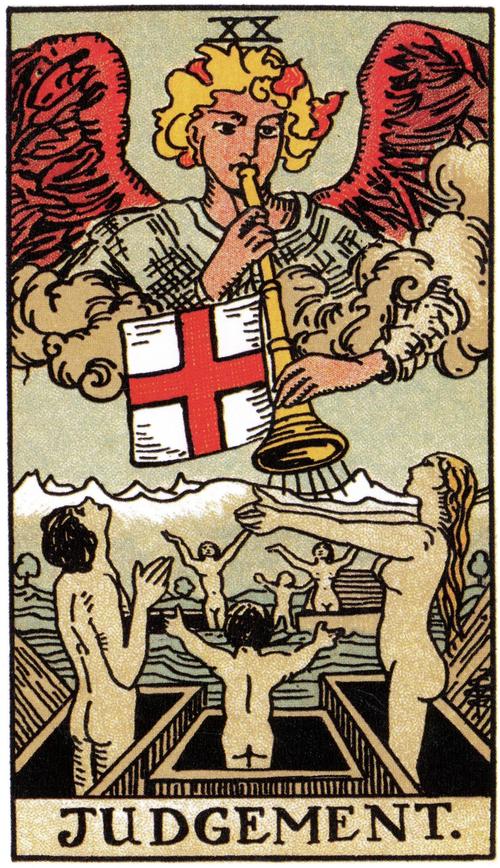
An angel fills the sky partially concealed by clouds. He blows through a horn and his red wings seem to emit a fiery glow on the angel’s hair. The angel represents the divine breath or the cosmic fire. The angel is Archangel Gabriel, who is known for revealing truths in several different versions of scripture. While the Bible does not explicitly mention Gabriel sounding a horn on Judgment Day, this depiction has become a prevalent motif over the centuries and is likely the inspiration for the card’s image. The horn is embellished by a flag with the equal armed cross of St. George. Down below we see floating coffins upon a sea of water, and there are men, women, and children with their arms extended out looking up to the angel. The bodies of these people are tinted gray, which indicates that the pairs of opposites have now been blended together and neutralized. This grey also indicates that the scene is not actually located in the physical plane, but it’s related more to a spiritual plane or to wisdom.
The fiery-winged angel hovers above the sea and the sound of his horn rings through the air. Archangel Gabriel, who is associated with the element of water, wears a blue robe. The action of heat, or the cosmic fire, upon water creates air. Gabriel utilizes sound and vibration, focusing the breath of life to send out light and energy. Sound is based on a seven-fold scale, which is indicated by 7 lines that radiate out from the horn. The coffins are rectangular and that represents our three-dimensional way of perceiving reality. It’s the limited, physical plane, which is an illusion. The coffins also represent one’s old personality. The true self rises up from the coffins, signifying that as humans we are not our body or personality, but spirit. The people are ascending to a higher dimension of consciousness.
The Judgement archetype is about healing and awakening. It shows us the power that the awakened mind has in giving birth to new forms. This is a later stage of spiritual unfoldment in which our personal consciousness is on the verge of blending with universal consciousness. This archetype is about facing responsibility and activating greater choice within our mission in life. It reveals what unwanted ties we need to let go of to fulfill our calling. The Judgement key is associated with people who’ve heard the call to a higher purpose in life. They actively pursue their own transformation and serve to help humanity succeed at making a collective shift in consciousness. They’re good communicators and do well as public speakers or authors. They are talented in sharing their perceptions in a way that is well-received and understood by others. These people use inspiration rather than fear to motivate people to pursue their divine purpose. They’re creative and dynamic, and others see them as perceptive, insightful, and intuitive. These strong leaders guide people into a new paradigm in order to create a new and better world.
SYMBOLS
Winged Angel: Archangel Gabriel
Flagged Horn: The horn is an instrument that expresses liberation. The horn is emblazoned with the flag of St. George. It is the flag of England.
The Man, Woman, and Child in the Foreground: These figures are believed to be the man, woman, and child from the Death card.
Clouds: The clouds provide a division between the upper and the lower, the mundane and the divine.
Open coffins: Six people, adults and children, rise up from open coffins with their arms held out to embrace their new life in wonderment. This is symbolic of resurrection, renewal, and regeneration.
Mountain Peaks: The white mountain peaks represent purity. This is an indication that the calling experienced in this card is of a higher nature.