DESCRIPTION
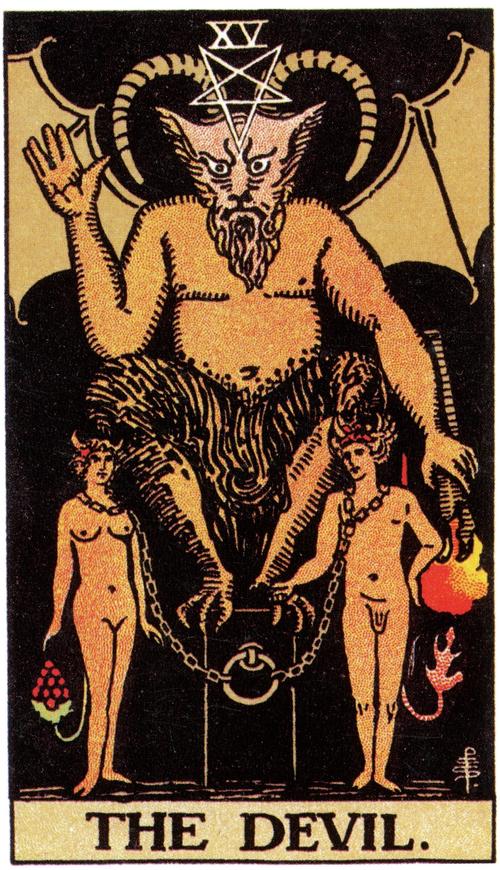
In 1857, Éliphas Lévi, a French occultist, released Transcendental Magic: Its Doctrine and Ritual, a work that significantly influenced modern tarot. Within this treatise, Lévi presented an intriguing illustration of Baphomet, referred to as the “Goat of Mendes,” even though the original Egyptian figure was a ram. Lévi’s captivating depiction of a goat-man crouched on a rock and gesturing with his right hand, left a lasting impact on the collective imagination and eventually was co-opted by followers of Satanism. This iconic image bears similarities to the Devil card in the tarot deck designed by Pamela Colman Smith. The Devil’s grimacing face reflects a Japanese print style. The Devil, with his right hand up and his fingers spread open, mocks the Hierophant’s esoteric sign of blessing of two fingers up and two down, symbolizing the hidden versus the revealed. His wings are bat wings, symbolizing the powers of darkness. His face and horns are that of a goat, relating him to the sign of Capricorn. His legs and feet are eagle’s claws, and the eagle is related to the sign of Scorpio, which rules the sex organs. There is an inverted pentagram that hovers between his horns, which represents matter (four) over spirit (one). Beneath the Devil’s feet rests a stone block that symbolizes the Cube of Matter or Malkuth.
The Devil card parallels the Lovers card, hinting at a continuation of the same narrative. Eve transforms into a horned woman, her tail bearing fruit like the Tree of Knowledge, while Adam becomes a horned man with a flaming tail reminiscent of the Lover’s Tree of Life. There is a torch held in the Devil’s left hand and pointing down, burning wastefully and giving off little light. The torch is also a phallic symbol, a symbol of life force, which here is being wasted. The man and woman chained to the devil’s stoop are obviously wasting their life force energy and using it unwisely. It’s being wasted through overindulgence, which can lead to exhaustion, boredom, and addictions. The illustration also shows the use of sexual energy to control or enslave others. This powerful generative energy has been debased and abused. The talons also symbolize how when we cling to this need to be right, despite all evidence to the contrary, we are in the Devil’s clutches. This key involves all matters of temptation of the ego. The man and the woman in the chains represent our self-conscious and subconscious modes of human thinking that have become trapped in material ways of being and thinking. Their horns, hooves, and tails show that when we get caught up in surface things, our consciousness becomes more beastialized. They’ve chosen to indulge their ego and prioritize things like materialism, sensory experience, and sexual gratification. Thinking that the illusion of the matrix is real causes enslavement, and the loose chains around their necks shows how the enslavement is voluntary.
We might be also chained to narrow perspectives or opinions or living according to other people’s expectations for us. We must understand that perceptions based in duality, separation, and materialism are false and illusory. The Devil thinks that the power comes from his own ego self and material gains. This kind of ego inflation is a real danger on any path of spiritual power.
When we feel our limitations and we become fed up with them, that’s what motivates us to actually free ourselves and choose to take our chains off. The Devil also represents the universal principle of mirth and humor, combined with stability. Those who embody this archetype find that it’s important to maintain a sense of humor and productivity at the same time. Think of a comedian who has an ability to bring humor to very worldly situations. Being able to accept and even laugh at our human foibles is one way to bring light to life’s situations.
SYMBOLS
The Devil: The Devil does not actually represent the fallen angel Lucifer, but instead he’s a result of projecting one’s shadow onto an adversary outside of oneself. Some believe the Devil figure to be Archangel Uriel.
Hand Gesture: Unlike the Hierophant, the Devil’s gesture is trying to tell us that we should believe that what we experience with our five senses is all there is.
Black Background: The color of the background represents darkness, ignorance, limitation, and also that which is hidden.
Loose Chains: The two human figures can easily lift the chains off and free themselves, but they don’t because they don’t seem to care. They have become limited by their attachments to half notions, ignorance, and illusions.
Horned Figures: The Lovers represent choice and discernment in our lessons of duality. With the Devil, they clearly haven’t been making wise choices. In place of the love and passion that was blessed by the angel in the Lovers card, here their passions have been misdirected to illusions and material addictions. Growth is stunted by the unwillingness to face one’s own shadow and to take responsibility for one’s decisions and actions.
Inverted Pentagram: The symbol of the pentagram normally represents the five elements, and it’s also a symbol of humans. An upright pentagram is a very positive symbol of man’s mastery of the elements in his ascent towards his divinity. The inverted pentagram suggests misunderstanding of our place in the cosmos. Rather than recognizing divinity, this inverted pentagram symbolizes the pursuit of things like sexual gratification and material gain above all else. The inverted pentagram also represents a disregard for spiritual laws and ethics and is used in black magic.
Half Cube Pedestal: The cube as a whole represents knowledge of reality. The half cube symbolizes half knowledge of reality. Half knowledge is thinking that the material realm of the five senses is all there is while ignoring or denying the hidden and spiritual side of life.