RIDER-WAITE-SMITH DESCRIPTION
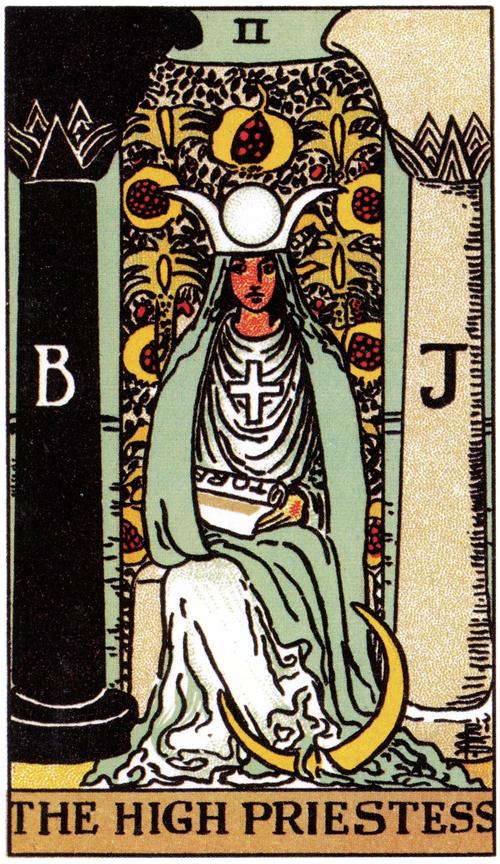
A solemn young female sits upon a throne with a crescent moon at her feet. While she’s in this position of high esteem, she’s rather young in appearance. The High Priestess sits inside a temple upon a cubicle stone, which represents the soul or the container for creation or the formation of matter. Her inner robes and her headscarf are white, representing her purity and her virginity. Her outer robe is blue which flows like a waterfall. This represents the stream of consciousness that flows through the rest of the deck. Anywhere that we see water in the remaining cards, the original source of that water is the robe of the High Priestess. The water represents that prima materia, the root of matter. According to ancient hermetic teachings, what causes matter to manifest are the thoughts of the One Mind. This is known as the first hermetic principle of mentalism, which says that The All is Mind. The High Priestess is the subconscious aspect of this universal mind. She is simply pure virgin potential. She is receptive and births whatever seeds the Magician plants within her. As her robe dissolves into water, it reflects the concept of water taking form while remaining pure, which correlates with virginity or purity. The High Priestess’ crown shows the phases of the moon, referring to the cycles of nature and the principle of rhythm. Her headdress and robes are drawn to replicate flowing water, and the Moon is at her feet.
She sits in front of a veil on which are pomegranates arranged in a Tree of Life pattern. The veil is stretched between two pillars and on the veil is an embroidery of pomegranates representing feminine sexuality as well as palm leaves which represent masculine sexuality. This relates to the hermetic principle of gender, that interplay of masculine and feminine energies that are needed for creation. The pomegranates portrayed, and partly obscured, on the veil are depicted in the form of the Tree of Life, reminding us that this is the pattern of all things. The horns of her crown touch Chokmah and Binah of the supernal triad on the tree, connecting her to the celestial realms. Behind the veil is a vast sea of cosmic mind. The veil itself might serve to separate the unconscious and conscious mind, the living and the dead, and the supernal realm from the mundane. Altogether, this collection of lunar symbols conveys notions of secrecy, divine knowledge, faith, divination, and implicit communication between the seen and unseen aspects of a unified whole.
The High Priestess, who sits between black and white pillars labeled B for Boaz & J for Jachin, represents the middle pillar. These pillars represent to principle of polarity, and the lotus flowers at the top of each of the pillars represent the blooming of feminine subconscious force. The scroll that peeks out from the position of Hod/Mercury an onto the High Priestess’ lap says TORA on it, which represents and relates to the laws of the universe. In times past, a High Priestess would be living in the cloisters of the ancient temples. A contemporary example would be a quantum physicist seeking to understand the laws of the universe and matter, often finding themselves relying on their own inner knowing.
SYMBOLS
Long cascading blue gown: Her robe flows in waves of energy. This represents the principle of vibration. It says that all things vibrate; all things move. The blue robes of the Priestess also bring to mind the Virgin Mary as the “Star of the Sea.”
Veil: The veil is decorated with pomegranates and palm trees. The pomegranate is associated with the Virgin Mary. In Christian symbolism, the pomegranate frequently graced the fabric of garments, representing the abundance of Jesus’ sacrifice and resurrection. Pomegranates are often portrayed in the hands of Mary or the young Jesus.
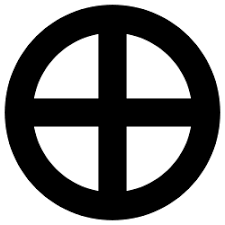
Equal-armed cross: The equal arm cross is positioned on her chest at Tiphareth, alluding to solar deities and the son, representing the balance of the four elements and the principle of correspondence, as above, so below.
Headdress crown with horns: This crown alludes to the solar disk, cow horns crown of Hathor. It also represents the Egyptian goddess Isis, who was the original High Priestess of the ancient Egyptian mystery schools. Some legends say that Isis taught women how to harness the cycles of nature, dig canals from the Nile, and water the fields. The crown may also represent a triple lunar crown reminiscent of Hekate as the maiden, mother, and crone.
Scroll: The word TORA is visible on the scroll in reference to the Torah, or law. This represents the divine law and alludes to gnosis, or self-knowledge.
Two Pillars: The black pillar to her right, which is marked with the initial B, is Boaz and the gray pillar to her left, which is marked with initial J, is Jachin. These pillars of Solomon’s Temple are called the Pillar of Form (Boaz) and the Pillar of Force (Jachin), and they are the two side pillars of the Tree of Life.